A wire harness can look perfect on the bench and still fail the moment it is plugged in. A terminal pushed into the wrong cavity, a loose strand touching the next circuit, or a crimp that holds only by friction will not show up in a photo. Wire harness testing exists to catch those problems before the harness reaches an assembly line or a piece of equipment in the field.
This guide explains the tests used most often, what each one detects, and how a test plan usually comes together. If you are new to the subject, it helps to start with what a wire harness is and how it differs from a cable assembly.
Why wire harness testing matters
A harness concentrates dozens or even hundreds of circuits into one part. Each extra wire, splice, and connector is another place where something can go wrong, and the cost of a fault grows the further it travels. A miswire found at the test station takes minutes to fix. The same miswire found after the harness is installed inside a machine can mean teardown, rework, and a missed shipment.
Most electrical tests are non-destructive, so they can be run on every unit. Mechanical tests such as pull tests destroy the sample, which is why they are done on a defined sampling plan instead.
Visual and dimensional inspection
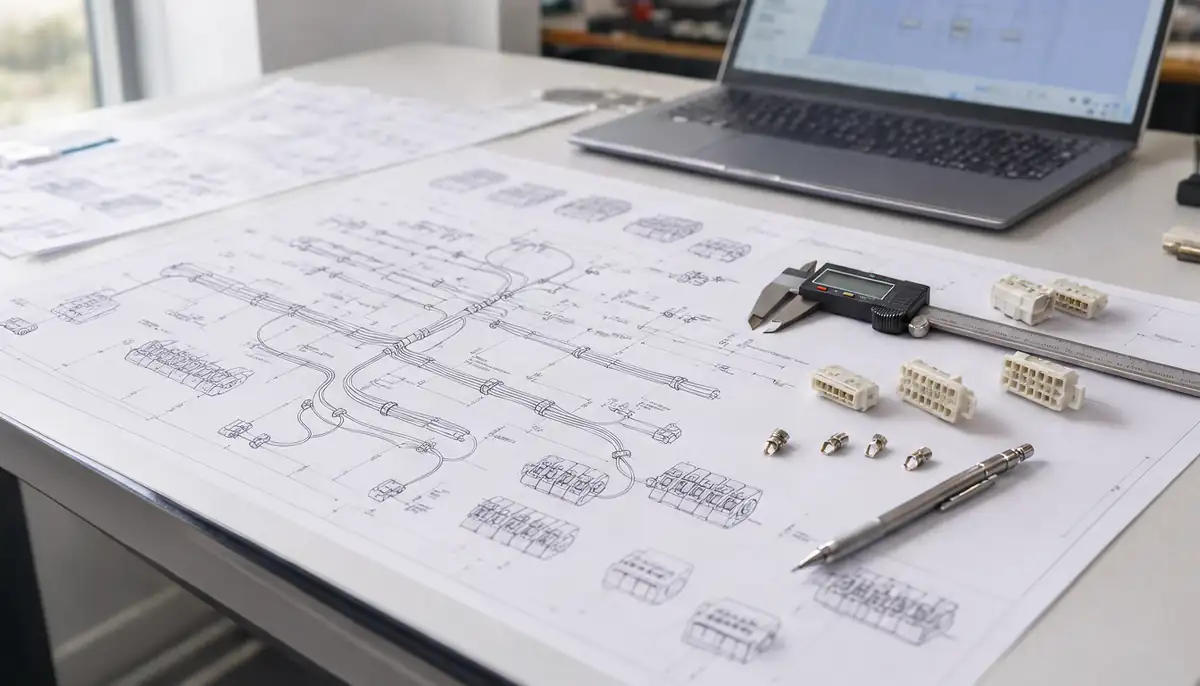
Inspection comes before any instrument is connected. Inspectors compare the harness with the drawing: overall length, breakout positions, labels, sleeving, and the orientation of each connector. They look for nicked or pinched insulation and check that every terminal is fully seated and that secondary locks are engaged.
Crimps get their own attention. A good crimp shows the conductor strands visible past the barrel, the insulation grip holding the jacket without cutting it, and a small bell mouth at the entry. Crimp height is usually measured with a micrometer when a machine is set up. Many manufacturers use IPC/WHMA-A-620, the industry acceptance standard for cable and wire harness assemblies, as the reference for what passes and what does not.
Continuity testing
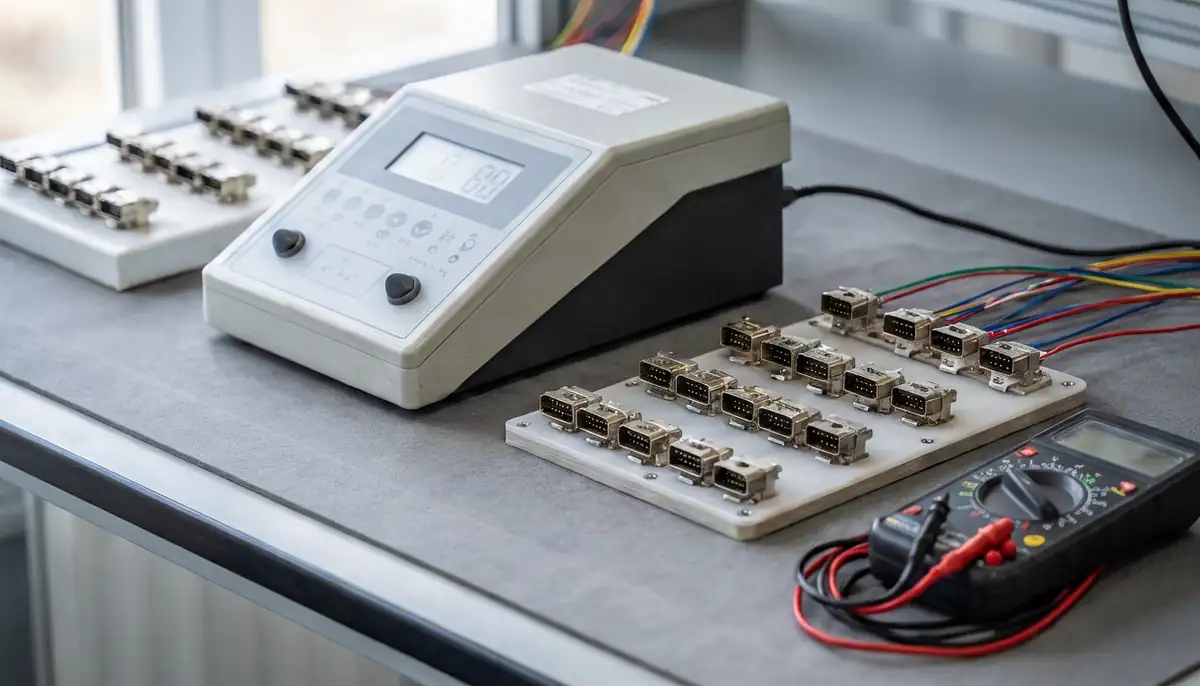
Continuity testing confirms that every intended connection exists. The tester sends a small signal through each circuit and checks that it arrives at the right pin on the other end. An open circuit, caused by a broken conductor, a missing wire, or a terminal that never latched, shows up immediately.
Automated harness testers work from a wire list, often called a netlist, that describes which points should connect. Because the tester knows the expected map, it can also report miswires: a wire that reaches the correct connector but lands in the wrong cavity.
Short circuit detection
A short is a connection that should not exist. Common causes are a stray strand left after stripping, insulation damaged during routing, or excess solder bridging two contacts. During the shorts test, the tester checks each point against every other point in the harness, so even a short between two connectors at opposite ends is found.
Some faults only appear when the harness moves. For those, technicians flex the bundle and connectors while the tester monitors the circuits, which helps reveal intermittent opens and shorts.
Resistance measurement
A basic continuity check passes any circuit below a set threshold, so a poor crimp or a conductor with broken strands can still slip through. Measuring the actual resistance of each circuit closes that gap. Results that run higher than expected for the wire gauge and length point to a weak crimp, damaged strands, or the wrong wire size. For very low values, four-wire (Kelvin) measurement removes the resistance of the test leads from the reading.
Hipot and insulation resistance testing
Continuity and shorts tests use low voltage. They will not tell you whether the insulation can handle the voltage the product sees in service. A hipot test, also called a dielectric withstand test, applies a voltage well above the operating voltage between conductors, and between conductors and any shield or ground. The tester measures leakage current, and a breakdown or excess leakage flags thin insulation, a nick, contamination, or conductors routed too close together.
Insulation resistance testing is closely related. It applies a DC voltage and reports the resistance of the insulation, usually in megohms. For both tests, the voltage, dwell time, and pass limits come from the product specification or the standard that applies to the end product. There is no single number that fits every harness.
Not every harness needs these tests. Low-voltage signal harnesses are often fully covered by continuity and shorts testing, while power distribution harnesses and those used in appliances, HVAC equipment, or industrial machinery are more likely to specify them.
Pull testing and crimp analysis
A pull test measures the force needed to separate a crimped terminal from its wire. The result is compared with a minimum value for that wire gauge, taken from the customer specification or from published tables such as those in IPC/WHMA-A-620 or UL 486A-486B. Since the sample is destroyed, pull tests are run at machine setup, after a tooling change, and at set intervals during production.
Cross-section analysis goes one step further. The crimp is cut, polished, and examined under magnification to check how well the strands are compacted and whether there are voids inside the barrel. It is common during process qualification and periodic audits.
Functional testing
Some harnesses carry components such as diodes, resistors, fuses, relays, or switches. A functional test plugs the harness into a fixture that simulates the final product, or into the product itself, and checks that everything behaves as designed. It is the closest check to real use and is usually defined together with the customer.
Quick reference: what each test catches
| Test | What it catches | Typical frequency |
|---|---|---|
| Visual and dimensional | Wrong lengths, missing labels, damaged insulation, unseated terminals | Every unit |
| Continuity | Open circuits, missing wires, terminals not latched | Every unit |
| Shorts and miswire | Unwanted connections, wires in the wrong cavity | Every unit |
| Resistance | Poor crimps, broken strands, wrong wire gauge | Every unit or as specified |
| Hipot and insulation resistance | Weak insulation, nicks, conductors too close together | As the product requires |
| Pull test | Weak or incorrect crimps | Setup and periodic samples |
| Cross-section | Internal crimp quality | Qualification and audits |
| Functional | Component and system behavior | As agreed with the customer |
How a wire harness test plan comes together
A test plan starts with the drawing and the wire list. From there, the manufacturer defines the test points, chooses which tests apply, and sets the limits: maximum resistance per circuit, hipot voltage and dwell time, and allowable leakage. A test fixture is built with mating connectors so each harness can be plugged in quickly and the same way every time.
The plan also covers sampling for destructive tests, what happens to a failed unit, and how results are recorded. Logging results by serial number or lot gives traceability if a question comes up later. The first units from a new setup are typically checked in full as a first article inspection before regular production begins.
If you are sourcing a harness, include your test requirements on the drawing when you request a quote. It avoids surprises in price and lead time, and it gives the supplier a clear target. A partner that offers custom wire harness manufacturing should be able to review those requirements and propose a test plan that fits the design. The same principles apply to simpler point-to-point cable assemblies.
Frequently asked questions
What is the difference between continuity and hipot testing?
Continuity testing uses a low voltage to confirm that each circuit is connected where it should be. Hipot testing uses a much higher voltage to confirm that the insulation between circuits will not break down. One checks the connections; the other checks the separation between them.
Is cable harness testing different from wire harness testing?
The terms are used almost interchangeably. Cable harness testing relies on the same methods: continuity, shorts, resistance, hipot where required, and mechanical checks on the terminations. The main difference is the design being tested, not the tests themselves.
Does every harness need a hipot test?
No. It depends on the operating voltage, the end product, and the standards that apply to it. Many low-voltage signal harnesses only need continuity and shorts testing. Power and appliance harnesses specify hipot more often.
How often are pull tests performed?
Pull tests are usually done when a crimp machine is set up, whenever the terminal, wire, or tooling changes, and at regular intervals during a production run. The exact frequency is set by the customer specification or the manufacturer’s quality plan.