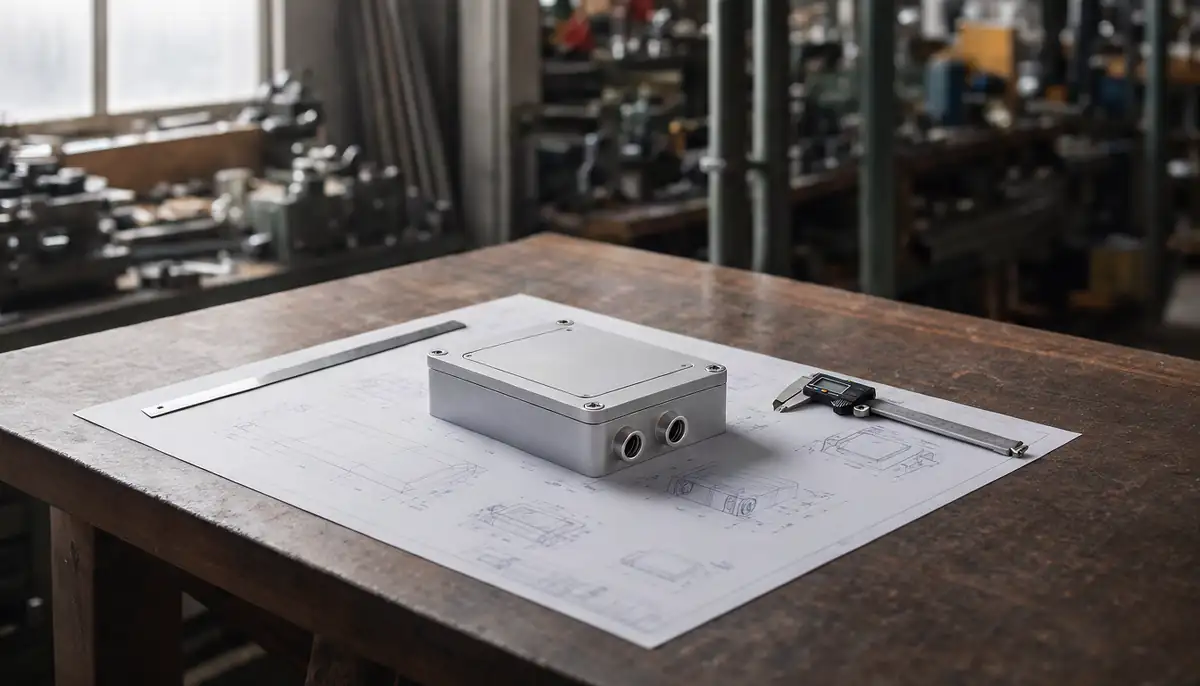
Build to print is a manufacturing arrangement in which the customer supplies a complete design package and the manufacturer produces the part or assembly exactly as documented. The manufacturer does not change the design. Its job is to source the materials, plan the process, build the product, and prove that it matches the drawings and specifications.
The model is common for machined parts, sheet metal, cable and wire harness assemblies, electronic assemblies, and control panels. This guide covers what build to print manufacturing involves, how it compares with other models, and what a buyer should prepare.
What build to print means in practice
In a build to print relationship, the customer owns the design and is responsible for how the product performs. The manufacturer is responsible for workmanship: building what the documents describe, using the specified materials, and meeting the stated tolerances and quality requirements. If the drawing is wrong, the product will be wrong too, which is why the quality of the design package matters so much.
This is different from a supplier that designs the product, and different from one that receives only a list of performance goals. The split of responsibility is the defining feature of the model.
Build to print vs. build to spec
Build to spec, sometimes called design and build, gives the manufacturer a set of requirements and leaves the detailed design to it. The supplier then owns more of the outcome, and usually charges for the engineering work.
| प्रिंट करने के लिए बनाएं | Build to spec | |
|---|---|---|
| Who creates the detailed design | ग्राहक | उतपादक |
| What the customer provides | Complete drawings, BOM, and specifications | Performance and interface requirements |
| Who is responsible for performance | ग्राहक | Shared or mostly the manufacturer |
| डिजाइन में परिवर्तन | Only with customer approval | Made by the manufacturer within the requirements |
| विशिष्ट उपयोग | Mature or proven designs, second sourcing, scaling production | New products, limited in-house engineering |
What goes into a build to print package
A strong package answers every question before it is asked. It usually includes:
- Drawings with dimensions, tolerances, and a current revision level
- निर्माता भाग संख्या और अनुमोदित विकल्पों सहित सामग्रियों की सूची
- सामग्री और फिनिश विनिर्देश
- The workmanship standard that applies, such as IPC/WHMA-A-620 for cable and harness assemblies or IPC-A-610 for electronic assemblies
- Test and inspection requirements, with acceptance limits
- Labeling, packaging, and documentation requirements
- An approved vendor list, if certain components must come from specific sources
For cable and harness work, the drawing itself carries most of this information. A separate guide explains what a complete wire harness drawing includes.
How a build to print project runs
The project starts with a request for quote. The manufacturer reviews the package, checks that every component is available, and flags anything unclear, such as a missing tolerance or an obsolete part. This review often includes design for manufacturability (DFM) feedback: suggestions that could lower cost or improve consistency. In a build to print arrangement, those are recommendations only. Nothing changes until the customer updates and approves the documents.
Once the order is placed, the manufacturer plans the process, buys materials, and builds the first units. A first article inspection compares those units with every requirement on the drawing. In some industries this follows a formal standard, such as AS9102 in aerospace, or a full PPAP submission. After the first article is approved, regular production begins, and any later change goes through an engineering change process with a new revision of the documents.
Advantages of build to print manufacturing
The customer keeps full control of the design and its intellectual property. Quotes from different suppliers are easy to compare because everyone is pricing the same documents. It is also a practical way to add a second source, move production closer to the end market, or scale up a design that has already been proven. Companies that use अनुबंध विनिर्माण often work this way, keeping engineering in house and outsourcing production.
जोखिम और उन्हें कम करने के तरीके
The main risk is that errors in the package get built exactly as drawn. Old drawings that have not kept up with field changes, components that are no longer made, and vague notes such as “per sample” are frequent sources of trouble. A few habits help:
- Review the package for completeness before sending it out for quotes.
- Ask suppliers to list every question and assumption in writing with their quote.
- Check component availability and life cycle status before release.
- Keep strict revision control so everyone builds from the same version.
- Approve the first article before committing to volume production.
ज़्यादातर पूछे जाने वाले सवाल
Can a build to print manufacturer suggest design changes?
Yes, and good ones do. Suggestions are usually shared during the quote review or after the first article. The customer decides whether to accept them and issues a new revision if it does.
Who owns the design in build to print?
The customer. The manufacturer uses the documents only to produce the parts ordered, and the terms are normally set out in the purchase agreement and a nondisclosure agreement.
Is build to print only for simple parts?
No. Complex assemblies such as control panels, electronic units, and multi-branch wire harnesses are often built to print. Complexity raises the importance of a complete package, but it does not change the model.